
















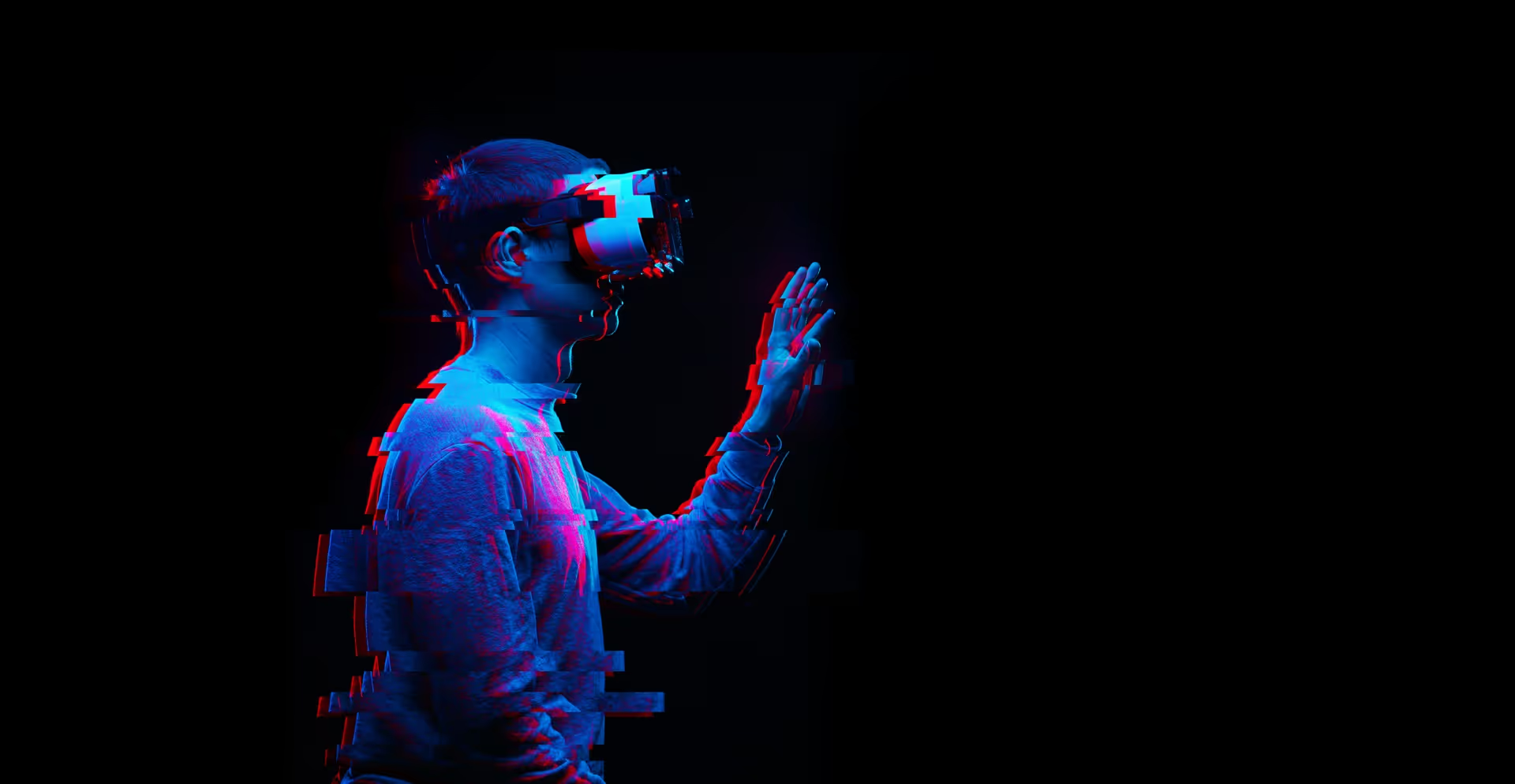




Patenting in relation to the metaverse is experiencing an upward trend driven by tech giants such as Apple, Microsoft, and Meta.
Further, the formation of the Metaverse Standards Forum indicates a growing commitment between standards organizations and companies to encourage the development of standards aimed at interoperability between technologies, which is necessary for an accessible and inclusive metaverse.
The momentum of innovation behind the metaverse is unlikely to subside anytime soon, which begs the question: in a technology landscape as wide-ranging as the metaverse, which contributions are protectable with patents?
How is the metaverse being patented?
The metaverse brings together both standard and new technologies, blurring the interface between virtuality and real-life. Last month saw the premiere of the Vision Pro - Apple’s answer to VR headsets - for which over 5,000 patent applications were filed.
These filings included the protection of features such as a “Head-mounted electronic device” (EP3901688A2), “Lens mounting structures for head-mounted devices” (EP3896509A1), and “Thermal regulation for head-mounted display” (EP3646684A1). But patenting the make-up of the metaverse can go much further than the hardware. For example:
- a method of image adjustment seeks to reduce the effect of motion sickness of a user (EP4189527 A1);
- the determination of a user’s attentive state uses “Eye-gaze based biofeedback” (EP4162345 A1); and
- devices, methods, and graphical user interfaces provide for interacting with three-dimensional environments (EP4034970A1).
What challenges are associated with patenting a metaverse invention?
A patent may be granted for an invention that is new and involves an inventive step, a requirement that becomes more nuanced when the invention involves the use of computer programs. This is because the law in Europe tells us that computer programs, as such, are excluded from patentability.
However, the above examples show what can be achieved - with the right drafting strategy - with regard to software-based inventions, by highlighting their technical character or technical contribution. By doing so, an applicant can overcome the eligibility hurdle set by many patent offices regarding patenting software inventions, such as at the EPO and UKIPO, which require that the software contributes to a further technical effect [1, 2] beyond the mere definition of a computer program as such.
What are further examples of metaverse patent applications?
Provided that a software invention makes a technical contribution to overcome the eligibility hurdle discussed above, the potential contributions of software innovations to a metaverse patent portfolio are much further reaching than one might assume. Examples from other big players in the metaverse innovation space include:
- “Systems and methods for authenticating a user of a head-mounted display” (EP4154138A1) - META PLATFORMS TECH LLC.
- “Foveated color correction to improve color uniformity of head-mounted displays” (EP3841566A1) - MICROSOFT TECHNOLOGY LICENSING LLC.
- “Occlusion of virtual objects in augmented reality by physical objects” (EP4111292A1) – META PLATFORMS TECH LLC.
In our next article, we will take a closer look at the role of specific technologies in the metaverse and the different types of IP protection available for these.
Potter Clarkson’s specialist electronics and communications team includes a number of patent and trade mark attorneys and IP solicitors with extensive experience in electronics, software, and AI inventions. If we can help you with an issue relating to the protection and commercialisation of innovation in any area of the metaverse, please get in touch.
References
[1] Following the EPO’s terminology in examining programs for computers, the terminology and approach adopted by the UKIPO is largely consistent with the EPO’s.
[2] A high-level definition is provided in the EPO’s Guidelines for Examination, G-II, 3.6 “A "further technical effect" is a technical effect going beyond the "normal" physical interactions between the program (software) and the computer (hardware) on which it is run. The normal physical effects of the execution of a program, e.g. the circulation of electrical currents in the computer, are not in themselves sufficient to confer technical character to a computer program (…).”.