



















News
The latest insights, sector developments and case updates from Potter Clarkson. Explore up-to-date content from our experts and stay informed on the issues shaping the IP landscape.

.jpg)
.avif)
How serious is the threat of counterfeit tobacco and vape products?
The tobacco industry is facing a potentially critical threat from counterfeiting. Fake cigarettes, vapes, nicotine pouches and other types of tobacco-based products pose significant health risks for buyers and reputational damage for manufacturers.

High Court upholds UKIPO decision: Halozyme's SPC appeal dismissed
On 16 December 2024, the High Court handed down its judgment in the case of Halozyme, Inc. v The Comptroller-General of Patents, Designs and Trade Marks. The Court dismissed Halozyme's appeal, upholding the decision of the UK Intellectual Property Office (UKIPO) to refuse two Supplementary Protection Certificate (SPC) applications related to human recombinant hyaluronidase (rHuPH20) in combination with the therapeutic antibodies trastuzumab (Herceptin®) or rituximab (MabThera®), respectively.

A decisive moment for engineering biology: UK must act now to realise benefits
“Don’t fail to scale: seizing the opportunity of engineering biology”: The 1st report of 2024-2025 session of the Science and Technology Committee of the House of Lords published today, on the topic of the opportunities presented by the Engineering Biology field, and the risks to the UK of not engaging fully with appropriate investment and supporting strategy.

GlobalFoundries and IBM settle their legal battle over trade secrets and breach of contract
Last Thursday GlobalFoundries and IBM announced they have reached a settlement in their long-running legal battle.

Enhancing cosmetic formulations: Do cosmeceuticals really work?
In recent years, the convergence of beauty and pharmaceuticals has given rise to a new category of skincare products: cosmeceuticals. Cosmeceuticals blend cosmetic and pharmaceutical benefits and are designed to address skin complaints such as acne, dermatitis, and signs of aging.

The future of aquaculture and IP
Aquaculture, also known as fish farming or aquafarming, is the rearing of aquatic species in a closed or controlled environment specifically for human consumption.

For a procurement officer, what makes a good IP provider?
Procurement professionals in corporates are no strangers to complexity. From negotiating supplier terms to managing risk and ensuring compliance, the role demands finely balancing cost-efficiency, reliability, suitability and long-term value.

CJEU clarifies SPC eligibility for combination products
The Court of Justice of the European Union (CJEU) has issued its long-awaited judgement on the interpretation of Articles 3(a) and (c) of the SPC Regulation in the joined cases C-119/22 and C-149/22.

Keeping an eye on a potential appeal when summoned to ex-parte oral proceedings
Following our previous top tips for success at examining division oral proceedings, we consider actions to take when responding to the summons and attending the oral proceedings that maximise your prospects for a successful appeal should your endeavours with the examining division ultimately prove unsuccessful.

First draft of the General-Purpose AI Code of Practice has been released
The European AI Office is currently facilitating the drawing-up of the General-Purpose AI Code of Practice (the “Code”). The European Commission published the first draft of the Code on 14 November 2024. Further drafts are to be prepared, with the final version of the Code forecast to be released by 2 May 2025, in accordance with Article 56 (Codes of Practice) of the EU AI Act.

The rise and rise of functional chocolate
The term ‘functional chocolate’ could well be new to you, but as we continue to look for healthier alternatives to the treats we all love, it is a term that you are likely to become more familiar with in the very near future. It looks as though functional chocolate will share a very similar rise in popularity to ‘alt chocolate’.
%203.jpg)
UPC’s first FRAND decision: Claimant friendly again?
The Mannheim local division of the Unified Patent Court (“UPC”) handed down a decision at the end of November 2024 on the issue of infringement of a Standard Essential Patent EP 2 568 724 B1 (“SEP”), held by Panasonic Holdings Corporation (“Panasonic”).

Enhancing cosmetic formulations: The power of packaging
In the competitive world of cosmetics, the secret to standing out lies not just in your cosmetic formulations but also in your packaging.

Burberry launches trade mark action against B&M over use of “furberry”
British luxury fashion house Burberry has recently launched a legal action in the UK High Court against discount retail chain B&M for trade mark infringement and passing off. Burberry alleges that B&M is falsely representing goods sold under its “furberry” pet brand.
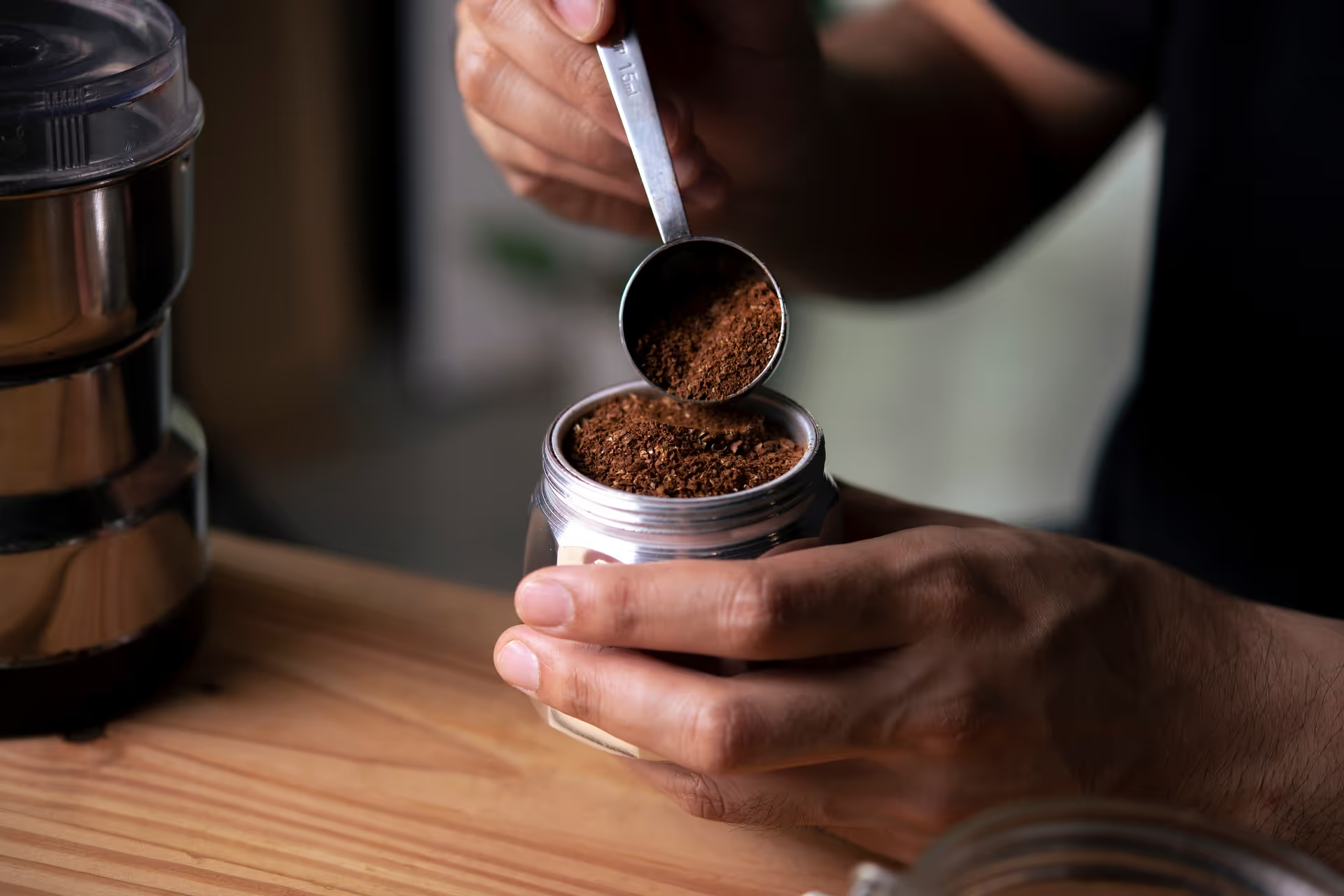
Food waste powers new battery breakthrough
Researchers at the University of New South Wales (UNSW) have discovered that wine and coffee byproducts could revolutionise battery technology. This innovative approach not only promises to make batteries more efficient and eco-friendly but also addresses significant sustainability concerns.

Hague Local Division considers doctrine of equivalents in UPC first
The UPC has published a landmark decision on the doctrine of equivalents, in which it not only formulated the UPC’s test for equivalents but also found infringement on this basis for the first time.